
China's 72-Hour and 144-Hour Visa-Free Transit: A Practical Guide for Business Travelers
Updated 2026-06-20
Over my 20 years sourcing in China, I've seen countless American buyers stress over visa paperwork for a quick layover in Shanghai or Beijing. The 72-hour visa-free transit policy is a game-changer for busy professionals: skip the embassy visit and save both time and money. If you're transiting through one of 15 eligible Chinese cities on your way to a third country, you might qualify—no visa required.
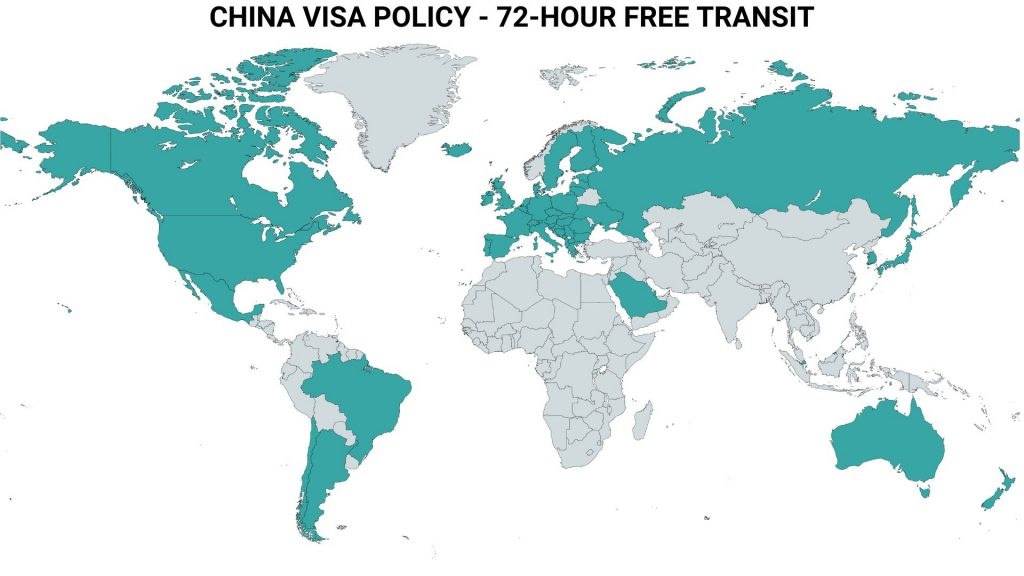
China Visa policy – 72-hour free transit
Update: Some nationalities do not need a visa to visit China for up to 30 days until the end of 2026. Check the details here.
Thanks to the 72-hour visa-free transit policy in China, air passengers from 52 countries are allowed to transit and stay for up to 72 hours in 15 China cities without a visa. It is possible that in the future, the list will be longer.
Which foreign nationals can stay in China without a visa?
Foreigners from 52 countries that enjoy the 72-hour China visa-free policy:
- 24 Schengen Agreement Countries: Austria, Belgium, Czech Republic, Denmark, Estonia, Finland, France, Germany, Greece, Hungary, Iceland, Italy, Latvia, Lithuania, Luxembourg, Malta, Netherlands, Poland, Portugal, Slovakia, Slovenia, Spain, Sweden, Switzerland
- 14 Other European Countries: Albania, Bosnia-Herzegovina, Bulgaria, Croatia, Cyprus, Russia, Ireland, the United Kingdom, Ukraine, Montenegro, Macedonia, Romania, Serbia, Norway
- 6 American Countries: Argentina, Brazil, Canada, Chile, Mexico, the United States
- 6 Asian Countries: Brunei, Japan, Korea, Singapore, United Arab Emirates, Qatar
- 2 Oceania Countries: Australia, New Zealand.
What are the requirements?
Foreign nationals who want to apply for the visa exemption have to provide the following:
- a valid international travel document
- air ticket for a connecting flight with a confirmed flight date and seat for a third country (region) traveling within 72 hours.
The transit passengers must arrive at eligible airports in Beijing, Guangzhou, Chengdu, Chongqing, Shenyang, Dalian, Xian, Guilin, Kunming, Xiamen, Wuhan, Tianjin, Haerbin, Qingdao, and Changsha with a connecting flight to a third country (region).
How to apply for the exemption?
If you are a foreign national coming from above mentioned countries and meet the requirements, submit your request to the airline company that carries you to China when boarding. The carrier will make the application to the border control authorities, and you will be granted a temporary entry.
The 72-hour period starts as soon as permission is issued. You should possess an air ticket to a third country (which may include Hong Kong or Macau), so it is impossible to travel on a route such as London-Beijing-London. For someone who is going to some Asian country and is changing flights in Beijing, the new law is very convenient and allows them to save money and time.
What to do after arrival?
At the airport, claim your luggage and go through customs. At the immigration, use the special lane/counter for your free transit. If you stay in one place for over 24 hours, register at the local police station. You do not have to do it if you stay at a hotel; the staff will do it for you. You can stop only in one city in mainland China.
After arrival, I have to leave the authorized region. What do I do?
If you have to leave the precinct, you must apply for a visa to the exit-entry administration department of the Municipal Public Security Bureau (PSB). If you fail to do so, your residence in China outside the designated area will be illegal.
Is it possible to leave China via another airport?
It is not possible, since you can only move within the designated precinct. For instance, if you arrive at Beijing Airport, you cannot leave China from Guangzhou. For the 72-hour TWOV (Transit Without Visa), you must enter and exit by the same port, but if you enjoy a 144-hour transit without a visa, you can enter/leave from sea/land ports if there are any in the area.
What about a 144-hour free-visa transit?
People transiting in the following areas that get the exemption can spend a 144-hour period instead of a 72-hour period:
- Guangdong – the whole province
- Qingdao – the whole Shandong Province
- Dalian or Shenyang – the whole of Liaoning Province
- Shanghai, Zhejiang, and Jiangsu can move around the three places
- Xi’an Xianyang Airport – Xi’an and Xianyang
- Beijing, Tianjin, and Hebei – within cities
- Chengdu, Kunming, Wuhan, Chongqing, or Xiamen – within cities.
Before you book that layover, remember that a quick transit trip is perfect for meeting suppliers or conducting preliminary factory walkthroughs. But never skip due diligence—use services like China-Check's supplier verification or quality control inspections to confirm your partner's credentials before you arrive. Plan your 72 hours wisely, and you'll turn a stopover into a productive sourcing trip.
Doing business with a Chinese company? Verify it before you commit
Run a verification →Verify before you pay
Get an independent due-diligence report on any Chinese company — registration, legal status, litigation and risk signals — delivered to your inbox.
Check a company now